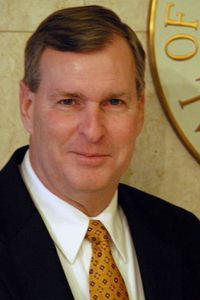
The Longest Shot in Indiana Politics
In 2007, Greg Ballard was a retired Marine lieutenant colonel with no political experience, no fundraising network, and no name recognition. He defeated a two-term Democratic incumbent to become mayor of Indianapolis, 51% to 47% -- the first time a sitting Indy mayor had lost reelection in 40 years. [1]
He knows what long odds feel like. He's about to find out if he can beat them twice.
On March 4, 2026, Ballard announced he was running for Indiana Secretary of State -- not as a Republican, the party he'd represented for eight years as mayor, but as an independent. Eight days later, he gave the effort a name: the Lincoln Party. [2]
"Both political parties are broken," he said in his announcement, "and we're the ones paying the price."
The Resume
Ballard's biography reads like it was assembled for exactly this kind of campaign. Born in 1954, he served 23 years in the Marine Corps, including deployment during Desert Storm, and was awarded the Legion of Merit. He holds a B.A. in Economics from IU Bloomington. After the military, he managed North American operations for Bayer Diagnostics before running for mayor. [3]
As mayor from 2008 to 2016, he governed as a pragmatic moderate -- a clean energy advocate who expanded Indianapolis's electric vehicle infrastructure and published a book on energy policy in 2019. He won reelection in 2011 with the same 51-47 margin, chose not to seek a third term, and left office without scandal. [1]
Then he disappeared from Indiana politics entirely. In January 2021, he moved to Myrtle Beach, South Carolina. [4]
Five years later, he's back.
Why He's Running
Ballard doesn't hide the target. His campaign is pointed directly at Diego Morales.
"The current leadership in that office has shown an eagerness to engage in partisan politics," he said. "I will not be the Republican or Democrat Secretary of State. I will be your Secretary of State." [5]
The pitch is simple: Indiana's chief election officer should be someone whose interest is administering elections competently, not someone accumulating scandals and using the office as a personal patronage operation. In a state where the incumbent has been banned from the Marion County Election Center, failed to properly certify candidacy filings, and hired his brother-in-law at a salary higher than his own, there's a market for that argument.
Whether there's a path is a different question.
The Wall: 36,943 Signatures
To appear on the November ballot, Ballard must collect 36,943 valid petition signatures from registered Indiana voters by June 30. [6]
That number is not a formality. It's a wall.
Indiana's ballot access requirements are among the most restrictive in the nation. Between 1892 and 2012, the state accounted for 20 of 401 instances nationally where independent candidates were required to collect more than 5,000 signatures. Most who try, fail. Paid signature circulators cost at least $15 per valid signature, and you need to collect far more than 37,000 raw signatures to survive the verification process -- rejected signatures, invalid registrations, duplicate entries. The ballot access effort alone could cost more than $700,000. [7]
Ballard estimates he needs $2 million total to run a competitive campaign. He has no established fundraising network in the state after five years in South Carolina. He has no party infrastructure. He's building from scratch, against two opponents who already have organizational advantages. [4]
The Spoiler Math
A three-way race in a deep-red state creates complicated dynamics.
An October-November 2025 poll showed Ballard at 23.8%, behind Democrat Beau Bayh at 31.5% and Morales at 28.5%, with 16.3% undecided. The margin of error was 4.9% -- meaning all three candidates were effectively within striking distance. [8]
Political scientist Laura Merrifield Wilson of the University of Indianapolis identified the core dynamic: Ballard appeals to "Republicans of the old age... the party of Lincoln" -- moderate Republicans and independents who've been alienated by Morales' scandals and Trump-era party direction. Those are voters Morales needs but has pushed away. [9]
That's the straightforward read: Ballard hurts Morales more than Bayh.
But it's not that simple. Some of those moderate voters might have drifted to Bayh as the strongest anti-Morales option. Ballard gives them a more ideologically comfortable place to park -- a former Republican, not a Democrat. He could simultaneously lower Morales' ceiling and limit Bayh's reach into the disaffected middle.
The Bayh campaign reportedly sees it both ways.
The Bigger Bet
The most interesting thing about Ballard's candidacy might have nothing to do with winning.
Under Indiana law, if a candidate running under a party label receives 2% or more of the Secretary of State vote, that party gains automatic ballot access for future elections. Future Lincoln Party candidates wouldn't need to collect signatures. [6]
Two percent is not 51 percent. It's a fundamentally achievable goal, even for a campaign that falls short of winning. And if Ballard hits it, he will have created something that didn't exist before: a permanent institutional pathway for moderate, governance-oriented candidates who don't fit in either major party.
That's a meaningful political contribution even in a losing campaign. It might be the point.
The Question
Ballard's biography is impeccable for this race: military service, executive experience, clean record, moderate temperament, the right enemy. In a different state with different ballot access laws, he'd be a serious contender.
In Indiana, he's fighting the math. The signature wall is real. The fundraising gap is real. The five years in South Carolina are real. And even if he makes the ballot, he's running in a state Trump won by double digits, against a Republican incumbent whose scandals have generated outrage but no actual electoral consequences.
He beat the odds once, in 2007, when nobody was watching.
This time everyone's watching. The question is whether that makes it easier or harder.