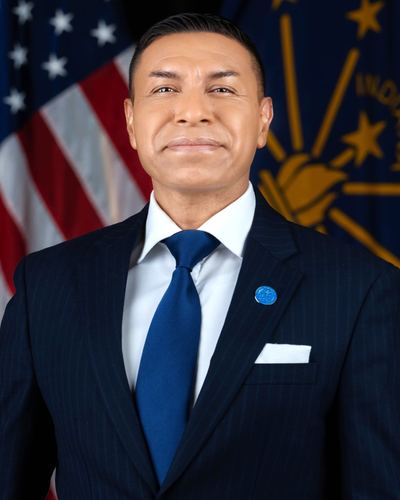
An American Story
Diego Morales was born in Guatemala in 1979. He immigrated legally to the United States with his family in 1999, arriving unable to speak English. [1]
What he built from there is, by any measure, remarkable. He graduated from Silver Creek High School in Sellersburg, earned a bachelor's from Indiana University, an MBA from Purdue, and an international MBA from Tilburg University in the Netherlands. He worked at Big 4 accounting firms, served on Governor Mike Pence's staff, and in 2022 became the first Latino elected to statewide office in Indiana's history. [1] [2]
That's the version you'd hear at a convention speech, and it's true. It's just not the whole story.
The Part They Leave Out
Before Morales was elected to lead the Indiana Secretary of State's office, he was fired from it. Twice.
In 2009, working under Secretary of State Todd Rokita, he was terminated after eight months for "incomplete" work, "inefficient execution," and "lack of focus." He refused to sign a work improvement plan. In 2011, under Secretary Charlie White, he lasted slightly over a month before being disciplined for "poor execution" and let go. He refused to sign that improvement plan too. [3]
Morales characterizes both departures as "disagreement in leadership, disagreements in opinions, probably office politics."
In 2018, he ran for Congress and finished third, dogged by accusations of exaggerating his military service -- describing himself as a "veteran" after three months in the National Guard with no active deployment.
Then, in 2022, he found his venue. At the Republican state convention, Morales upset the party-endorsed incumbent Holli Sullivan by a vote of 847 to 561, riding a wave of grassroots anger at the moderate wing. His supporters booed and heckled Sullivan from the convention floor. [4]
He'd won control of the office that had fired him. What followed was a campaign season that should have served as a warning -- and a tenure that proved the warning right.
The Campaign That Should Have Warned Everyone
Before the 2022 general election, three things happened that would have ended most candidacies.
First, Morales endorsed the false claim that the 2020 election was stolen. He joined the America First Secretary of State Coalition and wrote that he had "deep skepticism regarding the accuracy of the 2020 presidential election," calling it a "sham." After winning the nomination, he told The Washington Post that Biden had won legitimately. [5]
Second, two former Republican women came forward with sexual misconduct allegations from 2009. One said Morales invited her to "campaign sex" during her first week on the job and forcibly kissed her. The other said he pressured her for casual sex after dinner and insisted on entering her apartment despite her saying no "two or three times." Morales denied everything and called it politics. No charges were filed. [6]
Third, records showed Morales had voted in Hendricks County while simultaneously claiming a property tax deduction for residing in Marion County -- a deduction limited to a person's primary residence. An Indiana University law professor said Morales had potentially committed felony voter fraud. The candidate running on "election integrity" faced credible allegations of voter registration fraud. [7]
He won the general election with 54.1% of the vote. Indiana is a deep-red state. [8]
Six Scandals in Three Years
What followed has been the most scandal-dense tenure of any Indiana statewide officeholder in recent memory. The scandals don't require interpretation -- they are documented across dozens of independent news reports, confirmed by official proceedings, and span so many categories that they cannot plausibly be attributed to political animus.
The Filing Fiasco
In February 2026, Morales' office couldn't confirm whether the staffers accepting sworn candidacy filings were properly certified to do so -- potentially jeopardizing more than 800 candidacies. Morales called the concern "false." Then Republican legislative leadership directed its own candidates to refile their paperwork as a precaution, undercutting his claim in the most public way imaginable. [9] [10]
The Indiana Citizen's headline: "'UNCONSCIONABLE' CONFUSION."
Banned from the Election Center
The Marion County Election Board voted unanimously -- bipartisan -- to ban Morales from the non-public areas of the election center and refer him to the State Inspector General and Ethics Commission. His offense: incorporating footage from an official November 2024 visit into a campaign video. Election workers in the footage never consented to being filmed for campaign purposes. The clerk's office asked repeatedly to have the video taken down. Morales called the investigation "meritless" and "transparently political." The bipartisan, unanimous vote says otherwise. [11]
The Brother-in-Law
Morales hired his brother-in-law Shawn Grady as director of the auto dealer services division at $108,000 a year -- more than the Secretary of State's own salary of $94,501. Grady's previous job: car salesman at a southern Indiana dealership. Technically, Indiana's nepotism rules don't cover brothers-in-law. [12]
Then came the bonuses. Morales distributed more than $308,000 in spot bonuses to 68 of his roughly 75 employees in 2023, averaging $4,540 per person. Brother-in-law Grady received $12,500, pushing his first-year compensation to about $120,500. For comparison, the Attorney General's office -- five times the staff -- gave out $48,000 in bonuses total. Morales' office spent six times as much on bonuses with one-fifth the people. [13] [14]
The Donors Who Became Vendors
Morales' office awarded more than $3.3 million in no-bid contracts. The money flowed to companies whose leadership donated tens of thousands to his campaign. CleanSlate Technology Group: $2.3 million in no-bid contracts, $59,000 in donations -- its first-ever contribution to any Indiana candidate. MTX Group: up to $1.84 million in contracts (contract cap), $80,000 in donations from founder Das Nobel, including a single $50,000 check. [15]
The contracts weren't visible in the state's transparency portal. After media scrutiny, Morales' office started issuing formal RFPs. The legislature passed new transparency requirements. The horse was already gone.
The $90,000 SUV
Morales used taxpayer funds to buy a $90,000 GMC Yukon Denali from Kelley Automotive Group in Fort Wayne. Owner Tom Kelley had donated $65,000 to Morales' campaign, sits on the Motor Vehicle Advisory Board that advises Morales on auto dealer regulation, and already held nearly $15 million in state contracts that fiscal year. Donor, regulator, and vendor -- the same person, intersecting at the same office. [16]
A bill to restrict luxury vehicle purchases by state officials was killed in a closed-door committee meeting.
The World Traveler
In March 2025, Morales took a 10-day unannounced trip to India, missed his own budget hearing before the legislature, and refused to say who paid. Governor Braun said the trip "falls outside" the Secretary of State's responsibilities. In May, he went to Hungary, initially claiming "personal time" while social media showed him meeting government officials. His wife had been named honorary consul of Hungary to Indiana two months earlier. CPAC paid for the trip. [17] [18]
A new law -- enacted specifically because of Morales -- now requires annual travel reports. His showed $33,000 in state-funded travel across 19 out-of-state trips, including nine to Chicago to meet foreign dignitaries. He topped all statewide officials. [19]
"I Will Not Apologize"
When lawmakers hauled Morales before the House Ways and Means Committee and the State Budget Committee, the hearings covered everything: bonuses, the brother-in-law, no-bid contracts, the SUV, the travel. Sen. Fady Qaddoura said what most were thinking: "Those issues, when you put them together, it becomes extremely clear that your office is not being led transparently, with accountability or professionalism." [20]
Morales' response: "I will not apologize to anyone because my work ethic is unmatched."
Then the budget committee approved his $10.2 million budget increase. Bipartisan. [21]
That is the contradiction at the center of Indiana's relationship with Diego Morales: outrage without consequence.
To Be Fair
As of this writing, Morales has not been formally found in violation of any law. The brother-in-law hire technically doesn't break nepotism rules. The bonuses are within budgetary authority. He is the first Latino elected to statewide office in Indiana -- a genuinely historic achievement. He has visited all 92 counties, promoted the INBiz business portal, and his combative style resonates with the convention delegates who will decide his fate.
His convention nomination in 2022 was a legitimate grassroots uprising against an establishment candidate. He earned that.
But there is a difference between "not technically illegal" and "appropriate conduct for the state's chief election officer." Every scandal, taken alone, might be explained away. Taken together, they describe an office where public funds flow to family, donors become vendors, official resources become campaign material, and the response to every question is defiance.
What Happens Next
Morales faces two Republican convention challengers: Knox County Clerk David Shelton, who lost to him in 2022 and is running on "Restoring Integrity & Professionalism," and Jamie Reitenour, who advocates paper ballots and Trump alignment. [22]
If Morales survives the convention, he faces Democrat Beau Bayh -- the son of a former governor and senator, with $1.8 million raised -- and independent Greg Ballard, a former Indianapolis mayor running under the new "Lincoln Party" label who could siphon moderate Republican votes.
Sabato's Crystal Ball gives Morales an early edge. Indiana is a deep-red state. He has survived worse.
The question is whether convention delegates will reward the combative posture that got him here, or whether the accumulation finally catches up. Six scandals. Zero legal consequences. One office. And an incumbent whose answer to every accusation is the same four words:
I will not apologize.