The Name on the Ballot
In Indiana politics, some names carry weight the way steel girders carry a bridge -- invisibly, structurally, holding everything up. Bayh is one of those names.
Birch Bayh served three terms in the United States Senate. He authored the 25th Amendment, which established presidential succession. He authored the 26th Amendment, which gave eighteen-year-olds the right to vote. He wrote Title IX. His son Evan won the Secretary of State's office in 1986, the governorship in 1988 with 53% of the vote, re-election in 1992 with 63%, and then two Senate terms, both by margins exceeding 60%. [1]
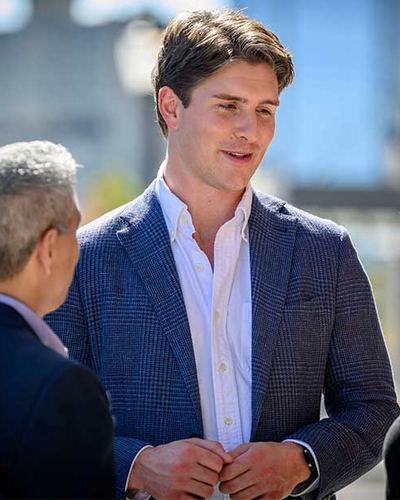
Now Evan's son, Birch Evans "Beau" Bayh IV, is running for the same office where his father started -- Indiana Secretary of State. He is 30 years old. He has never held elected office. And he has raised more money than any Democrat who has sought this position in over a decade. [2] [3]
The question this race poses is whether a famous name, genuine credentials, and a scandal-plagued opponent can overcome the gravitational pull of a state that hasn't elected a Democrat statewide since 2012.
Before the Campaign
Bayh's resume reads like it was assembled by someone who knew, from a young age, that he would eventually run for office -- though that may be unfair to a man who appears to have genuinely pursued each step on its own terms.
He graduated from Harvard with a degree in Government, where he was a Division I athlete and served on the Undergraduate Honor Council. Then came the Marines. Bayh trained at Quantico as an infantry officer, graduated from the Scout Sniper Unit Leader's Course, and rose to the rank of Captain. His deployment to Europe supported the U.S. response to Russia's invasion of Ukraine, where he served in Project Maven -- a top-secret intelligence program supporting U.S. and NATO operations -- and trained allied military forces in South America. He was honorably discharged in 2023 and continues to serve in the Marine Corps Reserve. [4] [5]
After the Marines, he went back to Harvard for law school, studying constitutional and administrative law. Following graduation in 2024, he clerked for Judge David F. Hamilton on the U.S. Court of Appeals for the Seventh Circuit in Bloomington, Indiana -- an Obama appointee who has served on that bench since 2009. [6]
Marine infantry officer. Classified intelligence work. Federal appellate clerkship. In a state with deep military connections -- multiple major bases, a large veteran population -- these are not decorative credentials. For a candidate with no governing experience, they provide a credible answer to "why should we trust you?" [7]
The Dynasty Question
There is no way to talk about Beau Bayh's candidacy without talking about what he inherited.
He announced on October 6, 2025, seeking the same office his father held as his first elected position nearly four decades earlier. The symbolism is unmistakable: Beau is walking the same path, in the same office, at roughly the same age. For older Indiana voters who remember Evan Bayh's sky-high approval ratings, this is a powerful signal. [2] [8]
But dynastic politics cuts both ways. Evan Bayh's post-Senate career -- joining a major law firm and a private equity firm -- drew criticism from progressives and may not play uniformly well. In an era of populist skepticism toward political establishments, the Bayh name can be framed as either "proven Indiana leadership" or "entitled insider." Whether it activates nostalgia or backlash depends on the voter. [8]
The Democratic nomination for Secretary of State is chosen at the party's state convention on June 6, 2026, not by primary voters. Bayh's only announced opponent for the nomination is Blythe Potter, a small business owner and Army Reserves veteran from Bargersville. Given Bayh's fundraising and name recognition, the convention is widely expected to be a formality. [2]
$1.8 Million and Counting
The money tells its own story -- though perhaps not the one the campaign would prefer.
Bayh raised $1.8 million in his first three months, entering 2026 with approximately $1.6 million cash on hand. That exceeded what any Democrat running for Indiana Secretary of State raised in an entire cycle in over a decade. By March 2026, the figure had climbed to nearly $2 million. [3]
The donor list, however, reads less like a grassroots uprising and more like a directory of Evan Bayh's professional network. Robert Johnson -- the BET founder and America's first Black billionaire -- gave $300,000, accounting for more than a quarter of the initial haul. The Simon family, connected to Simon Property Group and the Indiana Pacers, contributed over $230,000 combined. Former U.S. Attorney Dan Webb gave $100,000. Musician John Mellencamp and former Indianapolis mayor Bart Peterson each gave $10,000. Those three largest sources alone account for more than half the total. [3] [9]
The campaign reported that 85% of donors were from Indiana and that most individual donations were under $100. That statistic applies to the number of donations, not the dollar volume -- a distinction that matters. This is inherited infrastructure, not built-from-scratch organizing. It does not make the money illegitimate, but it tells a different story than "grassroots insurgent challenges corrupt incumbent." [9]
For context: incumbent Diego Morales reported approximately $1 million in cash on hand entering January 2026. Bayh holds a significant cash advantage, an unusual position for any Indiana Democrat, let alone one running for a down-ballot office. [3]
The Endorsement That Matters
VoteVets, the largest progressive veterans' organization, has endorsed Bayh's candidacy. The endorsement cites his Marine Corps service record and his stated intention to "apply military discipline to root out corruption, eliminate wasteful spending, and restore bipartisan common sense to Indiana's government." [10]
In a state that values military service, and against an incumbent facing ethics scandals, the VoteVets imprimatur is strategically significant. It gives Bayh a credential that transcends party -- or at least tries to.
The Numbers Game
An early poll offered Democrats their first quantitative reason for optimism. An InAct poll conducted October 24 through November 1, 2025 -- 400 likely general election voters, margin of error 4.9% -- found Bayh at 31.5%, Morales at 28.5%, and Greg Ballard at 23.8%, with 16.3% undecided. [11]
Caveats abound. The poll was conducted before Ballard formally launched his Lincoln Party campaign and before Morales' most recent controversies. A 4.9% margin of error on a 3-point lead is noise, not signal. But it was enough to place the race on the national radar.
Sabato's Crystal Ball, the University of Virginia's respected elections forecaster, rated the race "Likely Republican." Their analysis acknowledged the race was competitive enough to rate but concluded Indiana's deep-red structural lean gives Morales a significant advantage. They described Morales as "an aggressive retail campaigner" who "should be well funded" with a "solid" voter base. [12]
The structural challenge is real. Indiana has not elected a Democrat statewide since Joe Donnelly's 2012 Senate race -- and that required the Republican nominee to self-destruct with comments about rape and pregnancy. "Likely Republican" is where rational analysis lands, even with everything working in Bayh's favor.
The Three-Way Wildcard
What makes this race unpredictable rather than merely uphill is the potential three-way dynamic. If Greg Ballard qualifies for the ballot as a Lincoln Party candidate -- requiring approximately 37,000 petition signatures -- the calculus changes entirely. [13]
The key question is whether Ballard draws more from Morales' Republican base or from Bayh's moderate and independent support. If Ballard functions as a "permission structure" for Republican voters who cannot stomach Morales but cannot bring themselves to vote Democrat, he helps Bayh. If he splits the anti-Morales vote while leaving the party-line Republican vote intact, he helps the incumbent. The early InAct poll showed Bayh leading in a three-way field, but with 16% undecided and a large margin of error, that lead is less a prediction than a possibility. [13]
What He Doesn't Have
The profile would be incomplete without naming what is absent.
Bayh has never held elected office. He has never managed government operations, run a staff, or administered a budget. His legal career after law school consists of one clerkship. He is asking Indiana voters to entrust him with the administration of elections and the oversight of business filings based on credentials that are impressive but entirely outside government management. [1]
His platform -- election integrity, expanding early voting, fighting corruption -- is well-suited to the Secretary of State portfolio and provides a clear contrast with Morales' scandal-plagued tenure. But platforms are not experience. The question of whether a 30-year-old former Marine with a famous last name can actually run a state agency is one that credentials alone cannot answer.
The Convergence
What makes this race worth watching is not Bayh's resume or his fundraising alone. It is the convergence of forces around it: a weakened incumbent facing ethics investigations, a political dynasty reactivating after a generation, an independent Republican spoiler potentially fracturing the conservative vote, and a broader intra-party Republican civil war over redistricting that has fractured the Indiana GOP in ways not seen in decades.
Beau Bayh did not create these conditions. But he is well-positioned to capitalize on them -- the best-funded, best-credentialed Democratic challenger this office has seen in a generation, running at the one moment when the state's Republican machinery is most visibly cracked.
Whether that is enough remains an open question. "Best shot in a decade" still means uphill in Indiana. The race's outcome will depend less on Bayh himself than on whether the convergence of Morales' scandals, Ballard's independent bid, and the broader Republican fractures creates an opening wide enough for a Democrat to walk through. Voters should weigh his credentials and platform against his inexperience, and make their own judgment about whether the Bayh name represents continuity of public service or continuity of political dynasty.