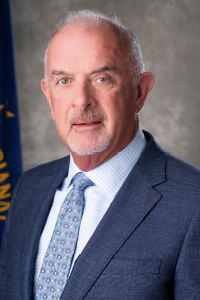
Of the six redistricting revenge races Trump launched against Indiana Republican senators, five are real contests. The sixth -- Senate District 19, in the rural northeastern corner of the state -- is something else entirely: a case study in what happens when a presidential endorsement arrives without an army behind it.
Trump endorsed Blake Fiechter to challenge Travis Holdman. Fiechter entered. Within a month, he quit, saying he felt like he was "on a raft alone trying to navigate." Then he visited the White House. Then he un-quit. As of late March 2026, he is nominally running a campaign with no visible staff, no social media presence, and a website that links to empty accounts.
The SD-19 story is not really about Fiechter or Holdman. It is about the floor -- the minimum that a presidential endorsement can produce when nothing else accompanies it.
Travis Holdman is not a backbencher. He is the third-ranking Republican in the Indiana Senate -- Majority Caucus Chair and chair of the Tax and Fiscal Policy Committee, which controls all state revenue and taxation legislation. He also sits on the Appropriations Committee and the Rules and Legislative Procedure Committee. In the informal hierarchy of the statehouse, few people matter more.
Holdman came to the Senate through appointment in March 2008, after the death of Senator David C. Ford. He won election in his own right that November and has held the seat since -- eighteen years by the time the May 2026 primary arrives. His background is law and banking: Deputy Prosecutor for Wells County, a partner at Lautzenheiser Myers and Holdman, then President and CEO of MarkleBank (later IAB Financial Bank) for twelve years before entering the Senate.
His sin, in Trump's eyes, was straightforward. On December 11, 2025, Holdman was one of 21 Republican senators who voted against HB 1032, the mid-decade redistricting plan. His explanation was blunt: "The message from my district has been clear -- they do not support mid-cycle redistricting, and therefore I cannot support it."
That vote put a target on his back.
On approximately January 23, 2026, Trump posted his "Complete and Total Endorsement" of Blake Fiechter on Truth Social. He called Fiechter "a True America First Patriot" and labeled Holdman a "RINO" who "for whatever reason, voted against Redistricting in Indiana, in a District that I won by 39 points, which puts the United States Congress in jeopardy."
There was one problem. Fiechter had not yet filed as a candidate. The endorsement preceded the candidacy -- a detail that tells you something about how these races were selected. This was not a grassroots insurgency looking for a national champion. It was a national champion looking for a warm body.
Fiechter filed shortly after, in late January 2026. He was 30-something, a real estate broker, a sixth-generation Wells County resident, a Norwell High School graduate, married with three daughters, and a Sunday School teacher at his church in Bluffton. His political experience consisted of one term on the Bluffton City Council -- an at-large seat he won in 2023 in his first run for office. Bluffton is a town of roughly 10,000 people.
Senate District 19 covers all of Adams, Blackford, Jay, and Wells counties plus a portion of Allen County in northeastern Indiana. The communities are small and scattered -- Bluffton, Portland, Hartford City, Decatur -- with no shared media market or organizational hub. Running a state senate campaign across five rural counties with limited population density, no major city, and no natural infrastructure for reaching voters requires precinct-level organizing, local fundraising networks, and sustained voter contact -- the kind of work that takes months of preparation and a team of committed volunteers.
Fiechter had a presidential endorsement. He did not have a team.
Roughly four weeks after entering the race, around February 24, 2026, Fiechter announced on social media that he was stepping away. His explanation was remarkably candid: "I felt like I was on a raft alone trying to navigate." He said he had received advice from some Republican leaders, but not enough help with campaign workers and money. The timing was notable -- his withdrawal fell after the ballot withdrawal deadline, meaning his name would remain on the May 5 primary ballot regardless of his intentions.
Then something unusual happened. On March 4, 2026, all six Trump-endorsed Indiana Senate challengers visited the White House for an Oval Office meeting with the president. Fiechter was among them -- despite having publicly dropped out of his race a week and a half earlier. One or two days later, Fiechter reversed his withdrawal, posting on Facebook: "After a lot of reflection, I believe stepping back into this race is the right thing to do."
But this time, he did not frame the race around redistricting. He cited a new issue: Holdman's vote on HB 1038, a casino bill that had passed the Indiana Senate 26-22 on February 24 -- coincidentally, the same day Fiechter dropped out. The bill would authorize a 14th state casino license in northeastern Indiana with a $500 million minimum investment and no local voter referendum. Holdman cast the deciding vote.
Holdman's response to the re-entry was dryly devastating. He told the Indiana Capital Chronicle: "I'm campaigning as though he's running against me. I can't keep up with his withdrawals and his ins and outs."
While the Republican primary has absorbed all the attention, SD-19 will also have a general election. Timothy C. Murphy filed as the sole Democratic candidate on January 7, 2026. Murphy is a pastor, a scholar, and an activist -- Senior Pastor at Plymouth Congregational Church (United Church of Christ) in Fort Wayne, with a Ph.D. from Claremont School of Theology and two published books on faith and social justice. A progressive UCC pastor running on universal childcare and union rights in a district where Trump won by nearly 40 points is not positioning for victory. He is positioning for presence -- ensuring that voters have a Democratic option on the November ballot and that the Republican nominee does not run unopposed for a fifth consecutive cycle.
The May 5 primary will ultimately measure something simple: in a district with no contested campaign, no challenger infrastructure, and no active voter contact operation, how many votes does the Trump name alone pull? If the answer is 20%, that is a curiosity. If the answer is 40%, that is a warning -- proof that the brand alone, even without a campaign, can threaten senior legislators. If Holdman wins by 30 or 40 points, it confirms what Fiechter discovered in his first four weeks: you cannot run a state senate race on an endorsement and a prayer.
The raft is still alone. The May 5 primary will tell us whether that ever mattered.