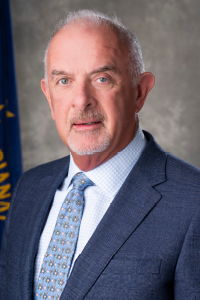

The Race That Wasn't (And Then Was Again)
Of the six redistricting revenge races Trump launched against Indiana Republican senators, five are real contests. The sixth -- Senate District 19, in the rural northeastern corner of the state -- is something else entirely: a case study in what happens when a presidential endorsement arrives without an army behind it.
Trump endorsed Blake Fiechter to challenge Travis Holdman. Fiechter entered. Within a month, he quit, saying he felt like he was "on a raft alone trying to navigate." [1] Then he visited the White House. Then he un-quit. As of late March 2026, he is nominally running a campaign with no visible staff, no social media presence, and a website that links to empty accounts. [2]
The SD-19 story is not really about Fiechter or Holdman. It is about the floor -- the minimum that a presidential endorsement can produce when nothing else accompanies it.
The Senator They Came For
Travis Holdman is not a backbencher. He is the third-ranking Republican in the Indiana Senate -- Majority Caucus Chair and chair of the Tax and Fiscal Policy Committee, which controls all state revenue and taxation legislation. He also sits on the Appropriations Committee and the Rules and Legislative Procedure Committee. In the informal hierarchy of the statehouse, few people matter more. [3]
Holdman came to the Senate through appointment in March 2008, after the death of Senator David C. Ford. He won election in his own right that November and has held the seat since -- eighteen years by the time the May 2026 primary arrives. [4] His background is law and banking: Deputy Prosecutor for Wells County, a partner at Lautzenheiser Myers and Holdman, then President and CEO of MarkleBank (later IAB Financial Bank) for twelve years before entering the Senate. He holds a B.A. from Southeast Missouri State University, an M.S. from the University of St. Francis, and a J.D. from Indiana University. [4]
His sin, in Trump's eyes, was straightforward. On December 11, 2025, Holdman was one of 21 Republican senators who voted against HB 1032, the mid-decade redistricting plan. His explanation was blunt: "The message from my district has been clear -- they do not support mid-cycle redistricting, and therefore I cannot support it." [5]
That vote put a target on his back.
The Endorsement Before the Candidate
On approximately January 23, 2026, Trump posted his "Complete and Total Endorsement" of Blake Fiechter on Truth Social. He called Fiechter "a True America First Patriot" and labeled Holdman a "RINO" who "for whatever reason, voted against Redistricting in Indiana, in a District that I won by 39 points, which puts the United States Congress in jeopardy." [6]
There was one problem. Fiechter had not yet filed as a candidate. The endorsement preceded the candidacy -- a detail that tells you something about how these races were selected. This was not a grassroots insurgency looking for a national champion. It was a national champion looking for a warm body. [6]
Fiechter filed shortly after, in late January 2026. [7] He was 30-something, a real estate broker, a sixth-generation Wells County resident, a Norwell High School graduate, married with three daughters, and a Sunday School teacher at his church in Bluffton. His political experience consisted of one term on the Bluffton City Council -- an at-large seat he won in 2023 in his first run for office. [8] Bluffton is a town of roughly 10,000 people.
None of this is disqualifying. But running for city council in a town you have lived in your entire life is a fundamentally different proposition from running for state senate across five counties spanning roughly 1,500 square miles.
Five Counties and No Campaign
Senate District 19 covers all of Adams, Blackford, Jay, and Wells counties plus a portion of Allen County in northeastern Indiana. [9] The communities are small and scattered -- Bluffton, Portland, Hartford City, Decatur -- with no shared media market or organizational hub. The Allen County portion is rural, not the Fort Wayne urban core.
This geography is the story. Running a state senate campaign in a compact suburban district is one thing. Running one across five rural counties with limited population density, no major city, and no natural infrastructure for reaching voters is something else. It requires precinct-level organizing, local fundraising networks, and sustained voter contact -- the kind of work that takes months of preparation and a team of committed volunteers.
Fiechter had a presidential endorsement. He did not have a team.
"On a Raft Alone"
Roughly four weeks after entering the race, around February 24, 2026, Fiechter announced on social media that he was stepping away. His explanation was remarkably candid: "I felt like I was on a raft alone trying to navigate." He said he had received advice from some Republican leaders, but not enough help with campaign workers and money. [1]
The timing was notable. Fiechter's withdrawal fell after the ballot withdrawal deadline, meaning his name would remain on the May 5 primary ballot regardless of his intentions. [1] Voters in SD-19 would see "Blake Fiechter" whether or not Blake Fiechter was actually running.
In those four weeks, the most powerful political endorsement in American politics had produced exactly one outcome: a candidate who entered a race, discovered there was no organizational support behind the endorsement, and quit.
The Oval Office Intervenes
Then something unusual happened. On March 4, 2026, all six Trump-endorsed Indiana Senate challengers visited the White House for an Oval Office meeting with the president. Fiechter was among them -- despite having publicly dropped out of his race a week and a half earlier. [10]
One or two days later, Fiechter reversed his withdrawal. He posted on Facebook: "After a lot of reflection, I believe stepping back into this race is the right thing to do." [11]
But this time, he did not frame the race around redistricting. He cited a new issue: Holdman's vote on HB 1038, a casino bill that had passed the Indiana Senate 26-22 on February 24 -- coincidentally, the same day Fiechter dropped out. [12]
The Casino Vote
HB 1038 would authorize a 14th state casino license in northeastern Indiana -- specifically in Allen, DeKalb, or Steuben counties -- with a $500 million minimum investment. The bill's most controversial element: no local voter referendum. Every previous Indiana casino authorization had included one. Holdman cast the deciding vote. [12]
Fiechter seized on this, attempting to reframe the race from "Trump versus a RINO on redistricting" to "an insider who voted against what his district wanted -- twice." It was a more locally resonant argument than the redistricting fight, which was always more about congressional politics than anything happening in Wells or Adams counties. [11]
Whether the casino angle has traction in SD-19 -- where the casino would not be located, but whose residents could plausibly feel affected by a major regional development decision made without voter input -- is an open question. And it is a question that would require a functioning campaign to answer. Fiechter does not appear to have one.
The Campaign That Isn't
Holdman's response to the re-entry was dryly devastating. He told the Indiana Capital Chronicle: "I'm campaigning as though he's running against me. I can't keep up with his withdrawals and his ins and outs." [2]
The Capitol Chronicle's own assessment was blunter. Fiechter's campaign is "bare-bones" -- a website that links to social media accounts with no posts. [2] No reported fundraising. No staff. No visible ground operation. The campaign infrastructure that did not exist before the withdrawal does not appear to have materialized after the re-entry.
The trajectory tells its own story: endorsed before filing, entered, withdrew within a month citing abandonment, visited the White House after withdrawing, re-entered citing a different issue. Each pivot coincides with presidential attention rather than organic local support. Fiechter's own words -- "on a raft alone" -- remain the most honest assessment of his campaign's organizational reality. [13]
The Democratic Candidate
While the Republican primary has absorbed all the attention, SD-19 will also have a general election. Timothy C. Murphy filed as the sole Democratic candidate on January 7, 2026 -- the first day of the filing period, and three weeks before either Holdman or Fiechter filed on the Republican side. [14]
Murphy is not a politician running a quixotic campaign. He is a pastor, a scholar, and an activist with a resume that belongs in a different kind of race.
Background and credentials. Dr. Timothy C. Murphy is the Senior Pastor and Teacher at Plymouth Congregational Church (United Church of Christ) in Fort Wayne, where he has served since August 2018. [15] He grew up in Kentucky, graduated from Centre College (2004), earned a Master of Divinity from Eden Theological Seminary (2007), and a Ph.D. from Claremont School of Theology (2014). [16] Before Fort Wayne, he served congregations and ministry organizations in Kentucky, Missouri, Texas, and California. He holds standing in both the United Church of Christ and the Christian Church (Disciples of Christ). [17]
Murphy's academic and professional work sits at the intersection of faith and social justice. He is the author of two books published by Chalice Press: Counter-Imperial Churching for a Planetary Gospel: Radical Discipleship for Today and Sustaining Hope in an Unjust World: How to Keep Going When You Want to Give Up. [17] He previously served as Executive Director of Progressive Christians Uniting in southern California and taught Religion and Politics at Claremont School of Theology. [17] In June 2025, he announced an indefinite hunger strike to pressure elected officials on humanitarian aid access to Gaza -- the kind of direct action that signals both conviction and a willingness to absorb personal cost for public witness. [18]
Platform. This is Murphy's first run for office. In his Ballotpedia Candidate Connection survey, completed in March 2026, he framed his candidacy around three themes: the political system's failure to represent ordinary Hoosiers; the need for a stronger safety net including universal childcare, paid leave, affordable healthcare, good-paying jobs, union rights, and progressive taxation; and opposition to the scapegoating of minority groups as a distraction from policies that benefit the wealthy. He describes his priorities as "expanding freedom and fairness" through education, healthcare, housing, and equal opportunity. [16]
The structural reality. Murphy's campaign faces arithmetic that no platform can overcome. SD-19 has not elected a Democrat in modern memory. The last time Holdman faced a Democratic challenger, in 2010, he won 72-28. [19] In 2014, 2018, and 2022, no Democrat filed at all. [19] Trump carried the district by 39 points. [6] Murphy lives in Fort Wayne, which sits in the Allen County portion of the district -- the rural fringe, not the urban core. His church is in downtown Fort Wayne, outside the district's political center of gravity.
A progressive UCC pastor running on universal childcare and union rights in a district where Trump won by nearly 40 points is not positioning for victory. He is positioning for presence -- ensuring that voters in Adams, Blackford, Jay, Wells, and Allen counties have a Democratic option on the November ballot, and that the Republican nominee (almost certainly Holdman) does not run unopposed for a fifth consecutive cycle. In a district where the real contest is the Republican primary, Murphy's candidacy is a structural act: it forces the general election to exist.
Whether Murphy can improve on the 28% that Robert Couse managed in 2010 -- the only modern benchmark for Democratic performance in SD-19 -- will depend on factors largely outside his control: turnout patterns, the residual effects of the redistricting fight, and whether any Republican voters disaffected by the primary cross over in November. His campaign website (murphyfor19.com) exists but shows limited visible activity as of late March 2026. [20] No fundraising totals have been publicly reported.
What SD-19 Tells Us
This race matters analytically not because it is competitive -- it almost certainly is not -- but because it reveals the structural limits of the retribution campaign. A Trump endorsement is a powerful signal. In a deep-red rural district where Trump won by 39 points, it carries real weight with voters. But weight with voters means nothing if there is no campaign apparatus to convert that weight into votes. Nobody is knocking on doors. Nobody is making phone calls. Nobody is organizing precinct captains across five counties.
Against that absence stands an 18-year incumbent who chairs one of the most powerful committees in the Indiana Senate, who has deep institutional roots in the district, and who has signaled no intention of backing down. Unseating a Tax and Fiscal Policy chair would send a message far beyond SD-19 -- it would demonstrate that no committee assignment and no leadership position can protect a legislator who crosses the president. [21] That makes Holdman a consequential target. It does not make Fiechter a consequential challenger.
The May 5 primary will ultimately measure something simple: in a district with no contested campaign, no challenger infrastructure, and no active voter contact operation, how many votes does the Trump name alone pull? If the answer is 20%, that is a curiosity. If the answer is 40%, that is a warning -- proof that the brand alone, even without a campaign, can threaten senior legislators. If Holdman wins by 30 or 40 points, it confirms what Fiechter discovered in his first four weeks: you cannot run a state senate race on an endorsement and a prayer.
The raft is still alone. The May 5 primary will tell us whether that ever mattered.