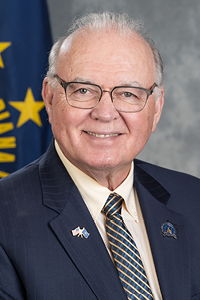
The Tool-and-Die Man
Jim Buck was born July 30, 1945, in Logansport, Indiana. He holds a bachelor's degree in business administration and an MBA from Indiana Wesleyan University. Before he entered politics, he worked as a tool-and-die mold maker, ran his own small business, and became a licensed real estate broker. He and his wife Judy raised five daughters. He is a member of the Rotary Club, Mason Lodge No. 93, and the Learning Network Board, and serves as vice president of the We Care board. [1]
That background matters. Tool-and-die work is precision manufacturing -- you build the molds that build everything else. It is exacting, methodical, and unglamorous. It is also the kind of work that, in north-central Indiana, earns a particular kind of respect. Buck came to the legislature from a factory floor, not a law firm.
Thirty-Two Consecutive Years
Buck's political career spans 32 years without interruption: 14 in the Indiana House (1994-2008) and 18 in the Senate (2008-present). He was selected by the Republican caucus to finish the term of Jeff Drozda in 2008 and has won every subsequent election. His general election margins tell the story of a man whose district knows him: 68.6% in 2010, unopposed in 2014, 65.4% in 2018, 64.0% in 2022. [2]
He has never faced a serious primary challenge. Not once in 32 years.
In the Senate, Buck chairs the Committee on Local Government and sits on five others: Homeland Security and Transportation, Environmental Affairs, Rules and Legislative Procedure, Judiciary, and Veterans Affairs. He announced his reelection campaign in August 2025, months before redistricting became an issue, on a platform of defending constitutional rights, lowering taxes, securing elections, combating illegal immigration, and empowering parents in education. [3] [4]
There is nothing in that list that a Republican primary voter in Howard County would find objectionable.
ALEC's National Chair
If Buck's legislative career were only about committee work and constituent service, it would be a respectable but unremarkable record. What elevates it -- and makes the "RINO" label so analytically striking -- is his role in the American Legislative Exchange Council.
ALEC is the most influential conservative state-policy organization in the country. It drafts model legislation on taxes, regulation, criminal justice, and federalism, and its member legislators introduce those bills in statehouses nationwide. Buck served as ALEC's national chair, currently sits on its board, serves as Indiana's state chair, and hosted the 2025 ALEC Annual Meeting in Indianapolis. [5]
This is not the resume of a man who stumbled into conservative politics. This is the resume of a man who helped build the conservative state-legislative infrastructure.
The Silent No
On December 11, 2025, Buck voted against HB 1032 -- Trump's mid-decade redistricting plan. He was one of 21 Republican senators who joined all 10 Democrats to kill the bill 31-19. [6]
Unlike Greg Walker in SD-41, who delivered 20 minutes of emotional testimony and accused the White House of violating the Hatch Act, Buck said nothing dramatic on the floor. He simply voted no. His reasons -- whatever they were -- remained largely private.
That silence was a choice. Walker made his opposition a public stand on principle. Buck treated it as a vote, not a speech. Whether that reflects discipline, temperament, or calculation, it meant there was no soundbite for the opposition to weaponize -- and no rallying cry for supporters to amplify.
"Pathetic RINO"
Trump took to Truth Social and called Buck a "pathetic RINO incumbent," writing that Buck "for whatever reason, voted against Redistricting in Indiana, which puts the United States Congress in jeopardy." He added that Buck and his "RINO friends made Indiana, a State I love and have been very good to, the only State in the Country that essentially said they don't care if Democrats steal Republican House seats." [7]
Buck's response was a study in strategic silence. He did not address the redistricting conflict. He did not mention Trump by name. He released a statement describing himself as a "principled conservative and staunch defender of the U.S. Constitution" and cited recognition from national conservative organizations and the Indiana State Police Alliance. [8]
No counter-attack. No apology. No explanation. Just a restatement of credentials and a bet that the voters of Howard and Tipton counties know who he is.
The Age Question
Jim Buck is 80 years old. He would be 81 by the time a new term begins in November 2026. In a race where the challenger announced in September 2025 -- three months before redistricting was an issue -- the original argument was generational change: a younger leader for a district represented by the same man since Bill Clinton's first term. [9]
Trump's endorsement of Powell transformed that conventional argument into something much louder, but the underlying question remains. Buck's age is the one vulnerability that existed before the redistricting vote and would have existed without it. The endorsement gave it a nationally amplified megaphone it would not otherwise have had.
What Buck Is Betting On
Buck's strategy is legible even without him articulating it. He is betting that 32 years of constituent service, a deep-red voting record, ALEC credentials, law enforcement endorsements, and institutional name recognition in a district he has represented since before some of his voters were born will outweigh a Truth Social post and the outside money that followed it.
He is betting that the voters of Senate District 21 know who Jim Buck is -- and that they will not be told otherwise by a president who, by his own phrasing, doesn't know why Buck voted the way he did.
It is the same bet that every targeted incumbent in these redistricting revenge races is making. Whether it pays off will be decided on May 5.
For the full race analysis including the challenger, outside spending, and district dynamics, see Buck vs. Powell -- SD-21.