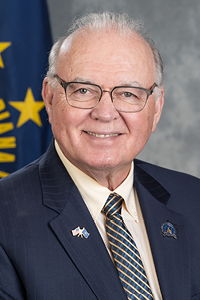

Thirty-Two Years and One Vote
Jim Buck has been in the Indiana legislature longer than some of his constituents have been alive. He won his first House seat in 1994, moved to the Senate in 2008, chaired committees, rose to become national chair of the American Legislative Exchange Council -- the most influential conservative state-policy organization in the country -- and never once faced a serious primary challenge. [1] [2]
Then, on December 11, 2025, he cast a single vote against Trump's mid-decade redistricting plan. And now the president of the United States wants him gone.
This is the story of SD-21: a race that started as a conventional generational-change primary and became a presidential loyalty test. It features an 80-year-old ALEC chairman who won't talk about redistricting and a county commissioner whose campaign changed its reason for existing halfway through.
The Incumbent
Jim Buck was born July 30, 1945, in Logansport, Indiana. He holds a bachelor's degree in business administration and an MBA from Indiana Wesleyan University. Before politics, he worked as a tool-and-die mold maker, ran his own small business, and became a licensed real estate broker. He and his wife Judy raised five daughters. He is a member of the Rotary Club, Mason Lodge No. 93, and the Learning Network Board, and serves as vice president of the We Care board. [1]
His political career spans 32 consecutive years: 14 in the House (1994-2008) and 18 in the Senate (2008-present). He was selected by the Republican caucus to finish the term of Jeff Drozda in 2008 and has won every subsequent election. His general election margins tell the story of a man whose district knows him well: 68.6% in 2010, unopposed in 2014, 65.4% in 2018, 64.0% in 2022. He has never faced a serious primary. [2]
In the Senate, Buck chairs the Committee on Local Government and sits on five others -- Homeland Security and Transportation, Environmental Affairs, Rules and Legislative Procedure, Judiciary, and Veterans Affairs. His ALEC credentials are substantial: former national chair, current board member, Indiana state chair, and host of the 2025 ALEC Annual Meeting in Indianapolis. [3]
This is not the resume of a man who stumbled into conservative politics.
The Vote That Changed Everything
Buck voted against HB 1032 on December 11, 2025, one of 21 Republican senators who joined all 10 Democrats to kill the bill 31-19. [4]
Unlike Greg Walker in SD-41, who delivered 20 minutes of emotional testimony and accused the White House of violating the Hatch Act, Buck said nothing dramatic on the floor. He simply voted no. His reasons -- whatever they were -- remained largely private.
What happened next was not private at all.
"Pathetic RINO"
Trump took to Truth Social and called Buck a "pathetic RINO incumbent," writing: "Tracey is running against a pathetic RINO incumbent named Jim Buck, who, for whatever reason, voted against Redistricting in Indiana, which puts the United States Congress in jeopardy." He added that Buck and his "RINO friends made Indiana, a State I love and have been very good to, the only State in the Country that essentially said they don't care if Democrats steal Republican House seats." [5]
Buck's response was a study in strategic silence. He did not address the redistricting conflict. He did not mention Trump by name. He released a statement describing himself as a "principled conservative and staunch defender of the U.S. Constitution" and cited recognition from national conservative organizations and the Indiana State Police Alliance. [6]
Whether that restraint is discipline or denial, it represents a fundamentally different bet than Walker made in SD-41 -- that the voters of Howard and Tipton counties know who Jim Buck is and will not be swayed by a Truth Social post.
The Challenger
Tracey Powell is a Tipton County Commissioner, chiropractor, farmer, and small business owner -- a "lifelong Hoosier." Since joining the commission in 2020, he has been active in the Indiana County Commissioners Association, serving as vice chair and chair of his region before being elected to the executive board as treasurer. He is also vice president of the North Central Indiana Regional Planning Council. In 2025, he received the Legislative Service Award from the Commissioners Association for his advocacy work. [7]
Here is the detail that matters most: Powell announced his candidacy in September 2025, approximately three months before the redistricting vote. His announcement had nothing to do with Trump or redistricting. He said: "State government needs leaders who understand the challenges faced by our local communities." He emphasized his rural background and his goal to "give our communities a stronger voice at the Statehouse." His platform was local: cutting taxes, strengthening schools, supporting healthcare access. [8]
It was a standard generational-change campaign. An 80-year-old incumbent. A younger challenger arguing it was time for fresh leadership. Nobody outside Howard and Tipton counties would have noticed.
A Campaign Rewritten
The redistricting vote in December and Trump's endorsement in late January rewrote Powell's candidacy.
On approximately January 27, 2026, Trump gave Powell his "Complete and Total Endorsement," calling him an "America First Patriot." Powell said he was "deeply honored," pledging to fight for "Hoosier values, secure our borders, strengthen our economy, and defend our constitutional freedoms." [5]
Compare that rhetoric to his September announcement -- "give our communities a stronger voice at the Statehouse" -- and the shift is plain. The borders-and-freedoms language was absent from the original campaign. The local county commissioner had become a national loyalty candidate.
On March 4, 2026, the transformation was complete. Powell was one of six Trump-endorsed Indiana Senate candidates who received an Oval Office meeting with the president. He posted video messages from outside the White House to his campaign social media accounts. [9]
A Tipton County Commissioner, filming campaign content from the White House lawn, for a state senate primary in north-central Indiana. That is the scale of what the redistricting fight introduced into this race.
The District
Senate District 21 encompasses all of Howard and Tipton counties and portions of Clinton, Grant, and Hamilton counties. Key communities include Kokomo -- Buck's home base, population approximately 59,000, a manufacturing city historically anchored by the auto industry -- and Tipton, Powell's home, county seat of Tipton County with a population of about 5,000. The southern edge of the district reaches into Hamilton County, including parts of Westfield and Sheridan. The district is solidly Republican. [10]
The Money Pouring In
The outside spending in this race dwarfs anything a state senate primary in Kokomo would normally attract.
Hoosier Leadership for America -- a dark-money 501(c)(4) affiliated with U.S. Senator Jim Banks and run by Andrew Surabian, a longtime Team Trump operative -- is running ads against Buck. The group plans to spend $3 million across seven state Senate races. FCC records show ad purchases in Indianapolis, Fort Wayne, Lafayette, and Terre Haute, plus digital platforms including YouTube. The ad content accuses targeted senators of opposing "President Trump's plan to remove liberal Democrats from Congress" and attacks votes on gasoline taxes, property taxes, and foreign land ownership. [11]
Club for Growth Action PAC, led by former Indiana Congressman David McIntosh, is sending mailers on Powell's behalf. At least one mailer focuses specifically on Trump's endorsement. [12]
Fair Maps Indiana leader Marty Obst has pledged his organization and others will "spend seven figures" supporting the Trump-endorsed challengers. [13]
On the incumbent side, Senate President Pro Tem Rodric Bray controls more than $3 million in campaign funds that could be deployed to defend targeted senators, though how those funds will be allocated remains unclear. [14]
The Mismatch
What is analytically striking about SD-21 is the distance between the attack and the record.
Jim Buck served as national chair of ALEC. He has a 32-year legislative career in a deep-red district. His general election margins have never fallen below 64%. He chairs the Local Government Committee. He announced his reelection in August 2025, months before the redistricting fight, with a platform built on defending constitutional rights, lowering taxes, securing elections, combating illegal immigration, and empowering parents in education. [15]
There is nothing in that list that a Republican primary voter in Howard County would find objectionable. The man is not a moderate. He is not a Democrat. He is a former ALEC national chair with law enforcement endorsements who has been winning elections in this district since Bill Clinton's first term.
And the president called him a "pathetic RINO" because of a single vote on a single bill.
Democratic Primary
While the Republican primary in SD-21 has attracted presidential attention and millions in outside spending, the Democratic side tells a quieter but structurally significant story. Two candidates -- Joseph Kazlas and Kirsten Root -- are competing for the Democratic nomination in a district that has not elected a Democrat to the state senate in decades. Neither has held elected office before. Both filed in January 2026. [16]
Joseph Kazlas
Navy veteran, UAW member, Stellantis worker, Kokomo
Joseph Kazlas is a Kokomo resident who served in the U.S. Navy from 1987 to 1991 as a communications electrician aboard the USS New Jersey (BB-62), completing two deployments -- one to South Korea, Australia, and Hawaii, and another to the Persian Gulf and United Arab Emirates. After leaving the Navy in 1991, he worked at Grissom Air Force Base before moving to Chrysler (now Stellantis), where he has worked for approximately 30 years. He serves on the Veterans Committee at UAW Local 685. [17]
Kazlas filed for the Democratic nomination on January 15, 2026. [18] His campaign has maintained a minimal public profile -- no campaign website, no identified endorsements, and no local news coverage of his platform or candidacy beyond filing records. He has not responded to the Ballotpedia Candidate Connection survey. [16]
Endorsements: None publicly identified.
Assessment: Kazlas brings a working-class biography rooted in the district's industrial core -- the kind of profile that once defined Howard County Democratic politics when Kokomo's auto plants were the backbone of the local economy. But without a visible campaign operation, public platform, or media engagement, it is difficult to assess what kind of race he intends to run. His candidacy may represent a placeholder filing or a low-budget effort built on personal networks rather than traditional campaign infrastructure.
Kirsten Root
Social worker, MSW, Sheridan
Kirsten Root grew up in La Porte and Rochester, Indiana, in a working-class family. She was the first person in her household to earn a master's degree, completing her MSW at IU Indianapolis. She worked full-time through college. [19] [20]
Her professional career has centered on crisis intervention and family services. She spent several years with the Indiana Department of Child Services in Hamilton County, working with families facing addiction, domestic violence, and limited access to supportive resources. She interned with Westfield Fire's Mobile Integrated Health program and with the IU Student Outreach Clinic ("Compassion Clinic"), a free health service in Indianapolis. She currently works as a middle school social worker. She has advocated for expanding social work approaches in public safety settings, including crisis response partnerships with the Sheriff's Department and Coroner's Office. [19] [21]
Root announced her candidacy on January 22, 2026, launching a community input survey alongside her announcement. [22] Her platform centers on four areas: healthcare access, ending corporate greed, public safety, and freedom and opportunity. She has pledged not to accept corporate PAC money and fundraises through ActBlue. [20]
In a March 2026 interview, Root highlighted the mental health crisis as a systems-level failure, noting that "law enforcement is telling her the same thing: jails have become the largest mental health providers in their communities." She has also emphasized education funding, housing affordability, and healthcare access as core concerns she hears across the district. [23]
Her framing is notably policy-specific for a first-time candidate: "We need people in these spaces making these rules who actually know what's going on on the front lines." [21]
Endorsements: None publicly identified at the time of this analysis.
Assessment: Root is running a more structured campaign than Kazlas -- she has a campaign website (rootforindiana.org), active social media accounts, an ActBlue fundraising page, local and university press coverage, and a clearly articulated platform rooted in her professional experience. Her social work background gives her a distinctive policy lens, particularly on mental health, child welfare, and public safety -- issues that do not break cleanly along partisan lines. The IU School of Social Work has profiled her candidacy, lending institutional visibility. [21]
The challenge Root faces is not rhetorical but arithmetic. SD-21 is deep-red territory. Buck won his last contested general election with 64% of the vote. Whoever wins the Republican primary will be the heavy favorite in November. Root's campaign appears oriented toward building Democratic infrastructure in a district where it barely exists -- a long-term investment rather than a short-term expectation of victory.
What This Race Is Really About
Both candidates are conservative Republicans. Powell's platform -- cutting taxes, strengthening schools, healthcare access -- does not differ materially from Buck's stated priorities. There is no ideological chasm here. The difference between them is one vote, and whether the president of the United States should be able to end a state legislator's career over it.
Powell faces the unusual challenge of having entered a race for one set of reasons and now running it for another. His September 2025 announcement emphasized local government experience and community voice. His post-endorsement messaging emphasizes borders, constitutional freedoms, and Trump's seal of approval. Whether voters see those as complementary or contradictory will shape whether the endorsement is an asset or a dissonance.
Buck, at 80, with 32 years in the legislature, has deep institutional ties and name recognition that no newcomer can match. But his age also makes the "fresh leadership" argument more potent, and Trump's endorsement gives that argument a nationally amplified megaphone it would not otherwise have had.
The May 5 primary will reveal whether the voters of Senate District 21 know Jim Buck well enough to disregard a president calling him a "pathetic RINO" -- or whether that label, amplified by millions of dollars in outside spending, overwrites three decades of constituent service.