In five other Indiana Senate districts, the story writes itself: a Republican senator voted against Trump's redistricting plan, Trump endorsed a primary challenger, and the machinery of punishment lurched into motion. Senate District 39 is the odd one out. Here, the target left before the shot was fired.
Eric Bassler announced his retirement in July 2025, citing twelve years as enough. Four months later, he publicly opposed Trump's redistricting push anyway, becoming the seventh Republican senator to break ranks. In December, he voted against HB 1032 as part of the 31-19 majority that killed the bill. Then he walked away -- on his own terms, with a Senate resolution honoring his service.
Trump endorsed Jeff Ellington for the open seat in February 2026 regardless. That decision is what makes SD-39 analytically interesting. Punishment is reactive. What happened here was something else: installation. Even with no enemy to defeat, Trump moved to claim the seat. The revenge campaign's second face -- patronage -- is most visible in the race where there is nobody left to punish.
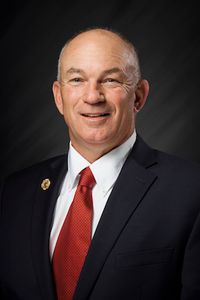
Jeff Ellington is a retired firefighter, a business owner, and a man who does not quit easily. He spent 29 years as a Rescue Technician with the City of Bloomington Fire Department, retiring in 2017. He runs J.R. Ellington Tree Experts, Ellington Stables, and Phoenix Demolition, and since 2018 has been restoring Bloomfield's historic Old Woolen Mill.
His political career began with an appointment to Indiana House District 62 on December 21, 2015. He won election in his own right in 2016, 2018, and 2020. Then redistricting took his seat away. Indiana's 2021 mapmaking moved Greene County from House District 62 into District 45, where incumbent Bruce Borders already held the line. Ellington challenged Borders in the 2022 Republican primary and lost, 46.7% to 53.3%. He ran again in 2024 in a three-way primary and finished third with 27.4%. Two consecutive losses. The state house door had closed.
So he pivoted. On August 8, 2025, Ellington filed for the SD-39 Senate seat. His campaign announced itself with familiar conservative priorities: protecting taxpayers, opposing tolling of Interstate 69, cutting fuel taxes, accelerating road repairs, immigration enforcement, and "America First" policies.
In February 2026, Trump endorsed Ellington on Truth Social, calling him an "America First Patriot" and giving him his "Complete and Total Endorsement." On March 4, 2026, Ellington was one of six Trump-endorsed Indiana Senate candidates who received an Oval Office meeting with the president. The other five were all challenging incumbent senators who had voted against redistricting. Ellington was the only one running for an open seat.
There is an irony at the center of Jeff Ellington's candidacy that is worth sitting with. He lost his House seat because of redistricting -- Indiana's 2021 maps merged his district with another incumbent's territory, and he lost twice trying to fight his way back. Now he is the beneficiary of a different kind of redistricting politics, endorsed by the president whose redistricting push the retiring incumbent rejected.
Tanner Bouchie is the local candidate in its purest form -- a Knox County lifer running for the seat that covers his home county on a platform built from the ground he walks on. A graduate of South Knox High School, Indiana University's Kelley School of Business, and IU's Maurer School of Law, Bouchie founded Bouchie Law LLC in Vincennes, the Knox County seat and Indiana's oldest city. He chairs the Knox County Board of Health, has served as president of both the Knox County Drug Court Foundation and the Knox County Bar Association. His platform is built around coal energy, rural first responders, and local infrastructure. He explicitly supports Trump's coal agenda and has promised to "work with Governor Braun to support coal energy production and coal jobs" while fighting "against destructive solar projects." This is his first run for public office.
Kristi Risk's candidacy is the most analytically interesting in the SD-39 field, because she occupies a position that should not exist: an insider to a Trump ally's operation who was passed over by Trump himself. Risk chairs the Owen County Republican Party and, since January 2025, has served as Director of Government Affairs for Lt. Gov. Micah Beckwith -- the official who conveyed Trump administration threats about withholding federal funding from Indiana over the redistricting dispute. She ran for Congress twice, earning 42% against incumbent Larry Bucshon in the 2012 8th District primary.
In 2026, she secured the endorsement of the Indiana Chamber of Commerce, which praised her commitment to economic growth. The Chamber endorsement is notable because it went to Risk rather than to the Trump-endorsed Ellington -- a signal that the business establishment's preferred candidate and the presidential endorsement point in different directions in this race. The question Risk's candidacy poses is pointed: if working directly for the lieutenant governor who carries Trump's messages to the Indiana Senate does not earn a Trump endorsement, what does?
The lone Democrat, Joseph Baughman, is a factory worker with 22 years in manufacturing who identifies openly as a "Christian Socialist," citing Jesus, Eugene V. Debs, Dr. Martin Luther King Jr., and Malcolm X as his political influences. He proposes a $19-per-hour minimum wage indexed to local cost of living, Rural Regional Training Centers, universal healthcare access, and a two-year moratorium on data centers with mandatory environmental impact investigations. In a district where "Democrat" is barely a functional category, his candidacy is less a bid for office than a public record of dissent.
For Republican voters in SD-39, the practical choice is among three conservatives with different patronage networks and different theories of what matters. Ellington carries the Trump brand and the hard-won resilience of a man who lost two primaries and kept running. Risk carries the Beckwith connection, the statehouse experience, and the Indiana Chamber endorsement. Bouchie carries deep Knox County roots and a coal-energy platform calibrated to the district's economic geography. All three would vote conservatively in the Indiana Senate.
What distinguishes the Republican primary is not ideology but alignment -- and whether a presidential endorsement, deployed in a state senate race where there is no incumbent to unseat, functions as decisive kingmaking or merely as one more data point in a rural primary where most voters know the candidates personally. SD-39 is where the redistricting revenge campaign reveals what it becomes when there is no one left to punish: a patronage operation, selecting allies for seats where dissent used to live.