Most of Indiana's redistricting revenge races follow the same basic script: a state senator votes against the president's mid-decade map, the president endorses a challenger, dark money arrives, attack ads run. It is blunt, expensive, and replicable.
Senate District 23 follows that script too. But it has something the other races do not: the Lt. Governor of Indiana personally recruited a member of his own staff to run the challenge.
That detail -- a sitting executive branch official deploying his own employee against a legislator from the same party -- turns SD-23 from a standard retribution contest into something structurally different. It is the executive branch intervening directly in a legislative personnel decision. And it is happening in a largely rural, west-central Indiana district of roughly 130,000 people, where the incumbent already beat this challenger four years ago.
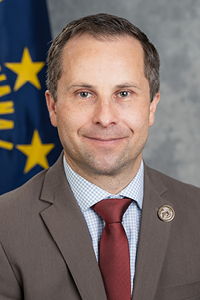
Spencer Deery is the kind of Republican who exists more comfortably in a Mitch Daniels administration than a Trump rally. He grew up in rural Indiana, the son of an elementary school principal and a public school teacher. Eagle Scout. BA in communications from Brigham Young University. Master's in public administration from the Trachtenberg School at George Washington University, where he graduated at the top of his class. He speaks fluent Spanish. For eleven years he worked in the President's Office at Purdue University as deputy chief of staff and communications advisor to Daniels.
He won the SD-23 seat in 2022, capturing 39.8% of a four-way Republican primary. Paula Copenhaver -- his current challenger -- finished third in that same race with 22.9%.
Copenhaver is from a different wing of Indiana Republican politics. Born and raised in Remington, she graduated from Tri-County High School and settled in Covington, a Fountain County town of about 2,600 people. She is a mother of five, a former Fountain County Clerk, a Covington city councilwoman, and the chair of the Fountain County Republican Party. She currently holds the title of Governmental Affairs Director -- North in Lt. Gov. Micah Beckwith's office.
She gained statewide notoriety once before. In October 2020, as Fountain County Clerk, she refused to wear a mask at early voting polling places -- while Fountain County was the worst COVID-19 hot spot in Indiana: 532 weekly cases per 100,000 residents, an 18.5% positivity rate, the only county in the state to receive a "red" score. She defied pandemic-era mandates from Governor Eric Holcomb and direct pleas from Secretary of State Connie Lawson, insisting the mandate "wasn't a law" and that she would only comply with legislation passed by the General Assembly. National media dubbed her "Indiana Karen."
On November 17, 2025, Deery was among the first Indiana state senators to publicly oppose Trump's push for mid-decade redistricting. His statement laid out a first-principles constitutional argument: "I took an oath before God to support the Constitution. There is no constitutional principle more basic than popular sovereignty and the idea that voters choose their leaders and shape their own destiny." He told the Christian Science Monitor: "I'm not taking this position because I'm opposing conservative values. I'm taking it because of my conservative values."
Three days after Deery's public statement, on November 20, 2025, police dispatch received a report of domestic abuse at his West Lafayette residence, including a threat of violence toward responding officers. Police thwarted the swatting attempt. The night before, someone had sent an unpaid pizza delivery to his address. Deery stated the pizza delivery was "an attempt to intimidate an elected official by conveying 'we know where you live.'"
When Copenhaver entered the race in November 2025, the recruitment was not subtle. Lt. Gov. Beckwith had personally recruited her -- his own employee -- to challenge Deery. Beckwith declared publicly: "I'm on a mission now." Her campaign announcement stated that Hoosiers have "watched weak leadership in the state senate fail to deliver the redistricting plan." Beckwith signaled that Turning Point USA and other outside money was being lined up for the race.
On January 28, 2026, Trump added his endorsement via Truth Social: "Paula is running against an incompetent and ineffective RINO incumbent named Spencer Deery who, for whatever reason, betrayed his voters by voting against Redistricting in Indiana." He called Copenhaver a "MAGA Warrior" and gave her his "Complete and Total Endorsement."
On March 4, 2026, Copenhaver was one of six Trump-endorsed Indiana Senate candidates who received an Oval Office meeting with the president -- campaign imagery that money cannot buy.
The outside money arrived on schedule. Hoosier Leadership for America launched television ads across the TV markets covering SD-23. The ads attack Deery for his vote on Senate Bill 1 (property tax reform in 2025), his opposition to redistricting, and his position on House Bill 1183 (farmland ownership restrictions). Club for Growth has distributed materials highlighting Trump's endorsement of Copenhaver. Turning Point USA is expected to participate.
On the other side of the ledger, Deery has the endorsement of former Governor and Purdue President Mitch Daniels, who gave it in a pre-recorded video played before Deery's campaign kickoff in mid-January 2026.
The 2022 primary provides a useful reality check. Copenhaver ran this exact race four years ago -- same district, same opponent, same primary format. Without Trump, without the redistricting controversy, without Beckwith, and without millions in outside spending, she finished third with 22.9% to Deery's 39.8%. The question this time is whether Trump's endorsement, Beckwith's recruitment, an Oval Office photo, and a dark-money air war can reverse a result that the underlying electoral math did not produce on its own.
Whoever emerges from the Republican primary will face two additional candidates in November. David Sanders, a Purdue biology professor and three-term West Lafayette city councilor, is the most persistent Democratic candidate in western Indiana's recent political history. His academic credentials include two U.S. patents on gene-therapy delivery and an NSF CAREER Award. He actually carried Tippecanoe County -- the district's population center -- with 53.06% in 2022 despite losing district-wide. He has sponsored ordinances banning facial recognition surveillance technology and founded the nonprofit Stop the Water Steal to oppose a major aquifer pumping plan. Joshua Brant is running as an independent with minimal visibility.
The core question for SD-23 voters is the same as in every redistricting revenge race, but sharper here because of the Beckwith dimension: should a state senator's re-election be determined by a single vote cast on behalf of the president's political strategy, or by the totality of their service to their district? And should the state's own executive branch be in the business of picking which legislators survive?