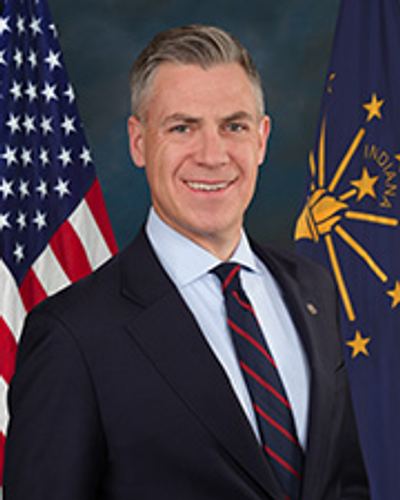
The Man Who Isn't on the Ballot
Jim Banks is not running for anything in 2026. He won his U.S. Senate seat in November 2024 with 57.7% of the vote, and he won't face voters again until 2030. He has no campaign to manage, no opponent to worry about, no fundraising deadline breathing down his neck. [1]
And yet, if you are a Republican state senator who voted against Donald Trump's redistricting plan on December 11, 2025, Jim Banks is the reason attack ads are running against you on television, radio, YouTube, and in your mailbox. He is the reason millions of dollars from donors whose names you will never know are flooding your district. He is, by every credible account, the operational architect of Indiana's redistricting revenge campaign.
He just doesn't want to talk about it.
The Resume
Banks was born July 16, 1979, in Columbia City, Indiana. He earned a BA from Indiana University Bloomington and an MBA from Grace College. He served as a Navy Reserve Supply Corps officer, including a deployment to Afghanistan in 2014-2015. [1]
His political career started where the current fight is happening: the Indiana State Senate. Banks represented the 17th district from 2010 to 2016, chairing the Senate Veterans Affairs and Military Committee. He served alongside some of the very senators his dark-money operation is now targeting. He knows the chamber. He knows the people. He knows how the votes work. [1]
In 2016, he moved to Washington, winning Indiana's 3rd Congressional District and serving four terms. He chaired the Republican Study Committee -- the largest conservative caucus in the House -- during the 117th Congress and founded the Anti-Woke Caucus. When Mike Braun left the Senate to run for governor, Banks ran unopposed in the Republican primary and defeated Democrat Valerie McCray 57.7% to 38.8% in the general. [1]
A safe seat. A rising profile. And a very specific set of tools for projecting power back into the state he left behind.
Three Days After the Vote
On December 11, 2025, the Indiana Senate voted 31-19 to kill Trump's mid-decade redistricting bill. Twenty-one Republican senators joined all ten Democrats in rejecting the plan.
Three days later, Banks appeared on Fox News Sunday. He called the vote a "missed opportunity." He stated plainly: "I stood with the president to support redistricting." And then the warning: "Donald Trump remains the most popular Republican in the state of Indiana. You don't want to be on the other side of Donald Trump." [2]
He described primary challenges against the dissenting senators as "healthy" for the party.
That was the public signal. What followed was the private machinery.
The Machine at a Residential Address
Hoosier Leadership for America is a 501(c)(4) nonprofit registered with the IRS, based at a single-family home on Fort Wayne's northeast side -- Banks' home city. Its treasurer is Charles Gantt of Massachusetts-based Bulldog Compliance. Every major Indiana political journalist describes it as "affiliated with" Banks. [3]
The group is run by Andrew Surabian, a name that means nothing to most Indiana voters but means a great deal in Trump's political orbit. Surabian was war room director on the 2016 Trump campaign. He served as a special assistant to the president and deputy strategist in the West Wing alongside Steve Bannon. He was one of the architects of JD Vance's 2022 Senate campaign and advised the VP campaign after that. He is described as a close adviser to both Vance and Donald Trump Jr. [4]
A residential address in Fort Wayne. A compliance firm in Massachusetts. A Trump-world operative at the helm. This is the structure behind the ads.
$3 Million Against His Former Colleagues
According to Politico reporting by Adam Wren, Hoosier Leadership for America plans to spend $3 million across seven state Senate races. The targeted incumbents are all Republicans who voted against redistricting: Jim Buck of Kokomo (SD-21), Spencer Deery of West Lafayette (SD-23), Greg Goode of Terre Haute (SD-40), Travis Holdman of Markle (SD-19), and Greg Walker of Columbus (SD-41). [5]
The ads aired on radio and television in Indianapolis, Fort Wayne, Lafayette, and Terre Haute, as well as on YouTube and other online platforms. FCC records confirm the placements. Mailers were sent from Virginia and Washington, D.C. -- not from Indiana. [5]
The ad content follows a specific pattern. Each one attacks a senator for opposing "President Trump's plan to remove liberal Democrats from Congress," then layers on unrelated votes -- gasoline taxes, property taxes, foreign land ownership -- to create a veneer of broad-based dissatisfaction. The ads direct viewers to call the state legislative switchboard rather than explicitly endorsing challengers, a common technique for 501(c)(4) issue advocacy that avoids express advocacy restrictions. [6]
The organizing principle is redistricting revenge. Every targeted senator voted against the map. The gas-tax and property-tax attacks are camouflage.
The Deniability Layer
When the Indiana Capital Chronicle asked Banks' office about Hoosier Leadership for America's advertising campaign, the office did not respond. [7]
This is how the structure works. Banks goes on national television to say primary challenges are "healthy." His affiliated nonprofit, run by a Trump operative, begins spending millions on attack ads against his former state senate colleagues. The 501(c)(4) designation means the organization is not required to disclose its donors. Voters in these state senate primaries will see the ads without ever knowing who paid for them. And Banks' office has no comment.
He is insulated on every side. A safe Senate seat not up until 2030. A nonprofit structure with no donor disclosure obligation. A spokesperson's silence. Yet every reporter covering Indiana politics connects the dots to him, and his own public statements confirm the alignment.
The Full Weight of the Machine
Banks' $3 million is the largest single piece, but it is not the whole picture. Fair Maps Indiana, led by Marty Obst -- a former Trump campaign staffer -- pledged "seven figures" of its own. The Club for Growth, led by former Indiana Congressman David McIntosh, had already spent approximately $425,000 on pro-redistricting advertising and phone campaigns. Turning Point USA is also expected to participate. Politico characterized the total as "a more than $5 million national money parachute into the Hoosier State." [8]
To appreciate what that means, consider the scale. A typical Indiana state senate race might see total spending of $100,000 to $200,000. Five million dollars in coordinated dark money -- dropped into a handful of down-ballot primaries from organizations based in Washington, Virginia, and Massachusetts -- is not politics as usual. It is an overwhelming force directed at legislators whose offense was voting their conscience.
What the Targets Are Saying
The senators under attack have noticed the asymmetry.
Greg Walker called the ads "over the top and ridiculous" and pointed out that "every dollar of this is coming from outside of District 41." Spencer Deery said the spending represents an attempt to "manipulate our elections, to intimidate future elected officials." [8]
These are Republican incumbents. They are being attacked by a Republican U.S. Senator's dark-money operation. Their crime was casting a vote in a state legislature where they were elected to exercise independent judgment.
The Bridge
What makes Banks uniquely dangerous to these senators is not his money alone -- others have money -- but his structural position. He is the only current federal officeholder from Indiana who both served in the Indiana State Senate and maintains a Trump-world political infrastructure through Surabian. Governor Braun supported redistricting but does not control a 501(c)(4). Lt. Gov. Beckwith conveyed federal funding threats but does not control ad spending. Banks combines institutional knowledge of the state senate chamber with a dark-money vehicle and a nationally connected operative to run it.
He is the bridge between Trump's national redistricting agenda and the television sets in West Lafayette and Terre Haute and Columbus. He translates presidential anger into ad buys. And the 501(c)(4) structure ensures that the translation is untraceable.
The Shadow Player
Jim Banks is not on the 2026 ballot. He holds a safe seat. His office declines to comment. And through Hoosier Leadership for America -- a nonprofit registered at a residential address, run by a Trump-world operative, funded by donors whose identities Indiana voters will never learn -- he is channeling at least $3 million into state senate primaries to punish members of his own party for a single vote.
He once sat in the very chamber whose members he is now targeting with dark money. He served alongside some of them. He knows their districts, their vulnerabilities, their constituents.
The total coordinated national spending in these down-ballot races may exceed $5 million -- an extraordinary sum for state legislative primaries, and a concrete measure of the cost of crossing Trump's redistricting agenda in Indiana. Banks is the man converting that agenda into action. He just prefers not to say so on the record.