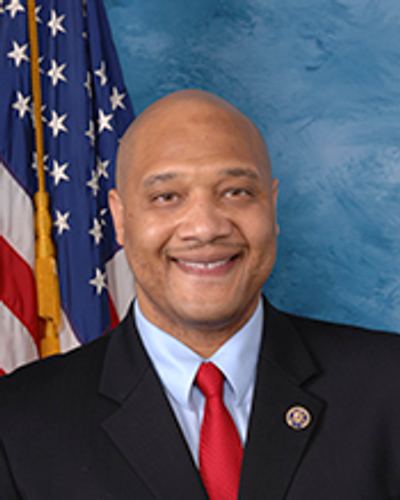
The Seat That Stayed in the Family
When Julia Carson died in office on December 15, 2007, she left behind more than a congressional vacancy. She left behind a political inheritance. Julia had held Indiana's 7th Congressional District since 1997 -- the first woman and first African American to represent Indianapolis in Congress. Her grandson, Andre Carson, won the special election to replace her in March 2008. He was 33 years old. [1]
Nearly two decades later, Carson still holds the seat. The family's continuous representation of Indianapolis in Congress now stretches close to thirty years. Whether you call that a dynasty or a tradition depends on your politics. Either way, it is a fact that shapes everything about IN-07.
The Man Behind the Name
Andre Darryl Carson was born October 16, 1974, and grew up on the east side of Indianapolis. He graduated from Arsenal Tech High School, earned a BA in Criminal Justice Management from Concordia University-Wisconsin, and later an MA in Business Management from Indiana Wesleyan University. [1]
Before Congress, his resume read more like law enforcement than politics. He served as a compliance officer for the Indiana State Excise Police from 1996 to 2005, then moved to the anti-terrorism division of Indiana's Department of Homeland Security and the Indiana Intelligence Fusion Center. He also served on the Indianapolis City-County Council. [1]
That intelligence background matters for what came next. Carson now sits on the House Permanent Select Committee on Intelligence -- the first Muslim member of Congress to do so. He also serves on the Transportation and Infrastructure Committee (where he is Ranking Member of the Aviation Subcommittee) and the Select Committee on the Chinese Communist Party. He is a Senior Whip for the House Democratic Caucus. [2]
Carson is one of four Muslim members of Congress, and his Intelligence Committee seat gave him a platform that drew national attention in May 2022 when, as Chairman of the Counterterrorism, Counterintelligence, and Counterproliferation Subcommittee, he convened the first congressional hearing on Unidentified Aerial Phenomena in over fifty years. [2]
An Island of Blue
What makes IN-07 interesting in 2026 isn't the race itself. It's the district's existence as a political anomaly.
Indiana's 7th is the state's only majority-minority congressional district: 49% white, 33% Black, 12% Hispanic or Latino. Its Cook Partisan Voter Index sits at D+21 -- the 49th most Democratic district in the country. In 2024, Kamala Harris carried it 70.0% to Trump's 28.0%. Carson himself won the general election that year with 68.3%. Every major forecaster -- Cook, Inside Elections, Sabato's Crystal Ball -- rates the 2026 general as Solid or Safe Democratic. [3]
In a state where Republicans hold every statewide office and eight of nine congressional seats, IN-07 is an island. And someone tried very hard to sink it.
The Map That Almost Erased Him
The Trump-backed redistricting effort that moved through the Indiana legislature in late 2025 would have eliminated Carson's seat entirely. The proposed map split Indianapolis into four congressional districts extending into surrounding rural areas, dismantling IN-07 as a distinct majority-minority district. Under those lines, there would have been no safe Democratic seat left in Indiana. [4]
The plan passed the Indiana House. Carson went public, warning that it would dilute minority voting power and calling the proposal "wholly unacceptable." [4]
On December 11, 2025, the Indiana Senate killed the plan, 31-19. Carson's political home survived -- but the vote was a reminder of something important. Even the safest seats are only as durable as the lines that define them. If the redistricting math changes in a future cycle, Carson's institutional strength may not be enough to save a district drawn to disappear. [4]
The 90-Percent Incumbent
Andre Carson does not lose primaries. He barely has them.
In 2020, he won 92% of the primary vote against Pierre Quincy Pullins. In 2022, he took approximately 94% against Curtis Godfrey and Pullins. In 2024, it was 91% against both Godfrey and Pullins again, with each challenger earning 5% or less. [5] These were perennial no-name candidates with minimal fundraising -- the kind of primaries that exist on paper but not in practice.
The 2026 primary is different. Not because the outcome is in doubt, but because the challengers are real people running real campaigns.
The Challengers
Three Democrats filed to challenge Carson. The most strategically coherent is George Hornedo, 34, who has been running since April 2025. A Cornell graduate with a Harvard education and a George Washington University law degree, Hornedo served in the Obama administration at the U.S. Department of Justice and worked on Pete Buttigieg's 2020 presidential campaign as National Deputy Political Director. He has raised $203,889 for the cycle, with $26,521 cash on hand as of December 31, 2025. He told Axios that "The win is inevitable because the community is clearly yearning for change," and he describes building "one of the largest Democratic field operations Indiana has seen in years." [6] [7]
The problem is structural. Hornedo spent much of the last decade outside Indianapolis -- in Washington and on the East Coast -- and returned full-time only in 2024. His $26,521 in cash on hand stands against Carson's $646,297. Enthusiasm is not the same as infrastructure. [7]
Then there is Destiny Wells, who filed on February 6, 2026 -- the absolute last day of candidate filing. Wells is a U.S. Army Reserve Lieutenant Colonel and attorney with statewide name recognition from two consecutive losing campaigns: Secretary of State in 2022 (lost by 13.9 points) and Attorney General in 2024 (lost 60-40 to Todd Rokita). She had no FEC-reported fundraising as of December 31, 2025. [6] [8]
The Hoosier Enquirer was blunt, characterizing her as a "perennial loser" making a "desperate last-minute bid." That framing is editorially harsh, but the factual pattern -- SoS loss, AG loss, last-day congressional filing with zero reported money -- supports the inference that Wells is testing offices rather than building a deliberate campaign for this one. [8]
The third challenger, Denise Paul Hatch, is a former Center Township constable. [6]
The Legislative Record Question
If a challenger wanted to build a case against Carson's performance, the GovTrack numbers offer raw material. In the 118th Congress (2023-2025), he introduced 20 bills. None were enacted. None even advanced out of committee. [9]
But context matters. Carson serves in the minority party of a Republican-controlled House. His cosponsorship activity tells a different story: 899 bills cosponsored, placing him in the 98th percentile and making him the 10th most active cosponsor among all Representatives. He ranked 2nd in leadership score within the Indiana delegation, maintained 97.8% attendance, and introduced seven bills with bipartisan cosponsors. [9]
The pattern -- high engagement, low passage rate -- is structural rather than personal. It reflects what it means to serve in the minority. The question for primary voters is whether they value seniority, committee influence, and coalition-building over the generational energy a challenger might bring. In safe-seat primaries, incumbents have historically won that argument with room to spare.
The Money
Carson has raised $641,826 for the 2026 cycle through December 31, 2025, and holds $646,297 in cash on hand with zero debt. PAC contributions account for roughly 52% of his total receipts ($335,050), with individual contributions at $228,760. He also sponsors a leadership PAC called "America Now." [10]
The PAC-heavy contribution mix is typical of entrenched incumbents in safe seats -- institutional Democratic money flows to members with seniority and committee influence, and Carson has both. His Q4 2025 fundraising came in at $156,400. [10]
Against this, Hornedo's $203,889 total and $26,521 cash on hand reveal a financial mismatch that campaign rhetoric cannot bridge. Wells has reported nothing at all. [6] [7]
The Dynasty Question
Andre Carson is the overwhelming favorite to win the May 5 Democratic primary and cruise to a tenth full term. His D+21 district, 91-94% primary track record, $646K cash advantage, and serious committee assignments make displacement by any current challenger implausible absent a scandal or fundamental realignment of Indianapolis Democratic politics.
But this primary signals something worth watching. Hornedo's year-long campaign and Wells' entry both reflect a generational restlessness -- a sense among some Indianapolis Democrats that a seat held by one family for nearly thirty years may eventually need fresh representation. Carson is 51 and shows no signs of stepping aside.
The redistricting fight crystallized the deeper reality. Carson's position depends not just on his own institutional strength but on the district lines that make that strength possible. The Indiana Senate killed the Republican map this time. If a future cycle brings different Senate math and the same political will, IN-07 as currently drawn could cease to exist.
For now, the primary is Carson's to lose. Nothing in the current field suggests he will.