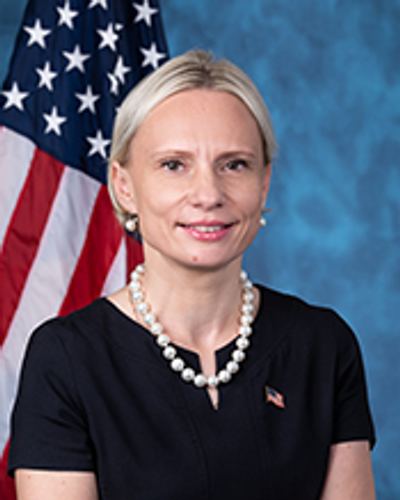
From Nosivka to Noblesville
Viktoriya Kulheyko was born on October 6, 1978, in Nosivka, a small city in Chernihiv Oblast, Ukraine -- then part of the Soviet Union. She immigrated to the United States in 2000, earned a Master of Professional Accountancy from the Kelley School of Business at IUPUI, became a Certified Public Accountant, and worked at Big 4 accounting firms before serving as CFO in the Indiana Attorney General's office. She and her husband Jason built a real estate and farming business in Hamilton County. In 2017, she was appointed to the Indiana State Senate after Luke Kenley resigned from District 20. In 2020, she won election to Congress. [1]
It is, on its face, an extraordinary American story. Victoria Spartz is the first and only Ukrainian-born member of Congress. She came from a country that would, two decades after her departure, be invaded by Russia -- and she would initially become one of the loudest voices in Washington demanding that America do something about it.
What happened after that is where the story gets complicated.
The Money Behind the Maverick
Congressional financial disclosures place Spartz's net worth somewhere between $3 million and $40 million -- a range that tells you more about the coarseness of disclosure requirements than about the actual figure. Her wealth derives primarily from real estate holdings, farmland, and the Westbrook Village mobile home park in Hamilton County. The Indianapolis Business Journal reported that the Spartz family owns at least 134 acres of farmland, residential parcels, and commercial property in Hamilton County, including a property sold for $5.1 million that had been purchased for less than $1 million. [2]
A DCCC review -- opposition research, noted with the appropriate grain of salt -- found discrepancies between Spartz's claimed 3,000 acres of farmed land and approximately 570 acres actually traceable through property records. That is an 81% gap between the claim and the documentation. [2]
The Retirement That Wasn't
On February 3, 2023, Spartz announced she would not seek re-election or any other office in 2024. She cited family obligations -- the need to spend more time with her two daughters. The announcement set off a gold rush. At least nine Republicans filed for what they believed would be an open seat in safely red IN-05, organizing campaigns, raising money, and building support structures around the assumption that Spartz was gone. [3]
Nearly one year later, on February 5, 2024, she reversed course. She would run after all. Her stated reason: she did "not believe she would be able to deliver on the important issues for our nation with the current failed leadership in Washington, D.C." [3]
The nine candidates who had organized their lives around an open seat were left to compete against the incumbent they had been told was leaving. Spartz won the May 2024 Republican primary with 39.1% against Chuck Goodrich (33.2%) and seven others. She then won the general election with 56.6%. [3]
That 56.6% number matters. It was the narrowest margin among Indiana's seven Republican-held seats -- by more than six percentage points. Other Indiana Republican incumbents ranged from 62.7% (Yakym, IN-02) to 68.0% (Messmer, IN-08). In a district with a Cook PVI of R+8, Spartz underperformed the partisan lean of her seat in a way that suggests her personal liabilities are dragging on her numbers. [4]
The Worst Boss in the House
In May 2022, Politico published an investigation naming Spartz the House's "worst boss." The designation was not editorial speculation. It was grounded in LegiStorm data showing she had the highest employee turnover in the House during her first year in office, and in interviews with more than a half-dozen former staffers. They described an environment of yelling, cursing, belittling aides' intelligence, and berating staff in front of members, constituents, and reporters. Spartz responded that her working style is "not for everyone" and that her critics "need to toughen up." [5]
The problem did not improve. By 2024, LegiStorm data showed Spartz's staff turnover rate had climbed to nearly 3.5 times the House average -- the highest it had been in her four-year congressional career. She tied with Rep. Henry Cuellar (D-TX) for second-highest turnover among all members of Congress that year. In June 2024, her chief of staff quit after less than a month on the job. Her communications director quit after less than five months. [6]
The House Ethics Committee -- a bipartisan body -- opened a preliminary inquiry in 2024 into allegations of "abuse," "rage," and "general toxicity" toward staff, as well as potential misuse of taxpayer resources for campaign purposes. The committee had delayed action to avoid the appearance of meddling in the primary. The November 2024 ethics report did not result in formal sanctions. Spartz denied the allegations. [6]
Denial is one thing. A 3.5x turnover rate is data.
The Vote That Echoed in Chernihiv
On April 20, 2024, Spartz voted against the $61 billion Ukraine aid package. The bill passed 311-112. She was one of 112 Republicans who voted no. [7]
The timing was brutal. Days before the vote, a Russian missile struck Chernihiv -- her home city -- during morning rush hour, killing 18 civilians. [7]
This was a woman who had emerged after Russia's 2022 invasion as one of Congress's most forceful voices on Ukraine. She had traveled to the country, spoken with moral authority about Russian aggression, and leveraged her personal connection to Ukraine in a way no other member of Congress could. Then, as her party's center of gravity shifted against Ukraine aid, she shifted with it. She cited concerns about oversight, accountability, and "blank checks" -- a coherent position on its own terms, and one shared by many House Republicans. [7]
But in Chernihiv, the people who had once claimed her as "one of their own" did not parse the policy nuance. The Washington Post reported anger and a sense of betrayal. [7]
Whether Spartz's position reflects principled fiscal conservatism or partisan drift is a question voters will answer for themselves. The factual record is clear: she was for Ukraine aid before she was against it, and the shift tracked precisely with her party's trajectory.
The Boycott
In December 2024, Spartz announced she would boycott all committee assignments and the GOP caucus in the 119th Congress. She declared she would instead focus on supporting DOGE-related government efficiency efforts alongside Representative Thomas Massie. [8]
This is without precedent for a member seeking re-election. Committee assignments are the primary mechanism through which House members exercise legislative power. Declining them is, functionally, declining to do the job. [8]
Her constituents noticed. At a March 2025 town hall, attendees jeered and chanted "Do your job!" for nearly two hours. They criticized her DOGE support and her refusal to call for Secretary of Defense Pete Hegseth's resignation. The scene was not a partisan ambush -- it was a Republican-leaning district telling its representative that alignment with Elon Musk's efficiency crusade was not an adequate substitute for constituent service. [8]
The Pattern
There is a through-line in Spartz's record that is worth naming: defiance, followed by partial capitulation, followed by symbolic dissent.
On the Republican budget resolution in early 2025, she initially opposed it. Under reported pressure from President Trump, she reversed. Then, on the final "One Big Beautiful Bill" in July 2025, she tweeted that she would "vote for the bill" but "vote against the rule due to broken commitments by @SpeakerJohnson." The Clerk of the House roll call record shows she voted for both -- YEA on the procedural rule at approximately 3 a.m. (Roll Call 189, 219-213) and YEA on final passage (Roll Call 190, 218-214). [9]
The pattern is consistent: public defiance that evaporates when the vote actually matters.
GovTrack records show Spartz has missed 150 of 2,696 roll call votes (5.6%) from January 2021 through March 2026 -- more than double the House median of 2.1%. Her Heritage Action scorecard scored her at 92% in the 117th Congress, placing her among the most conservative House members. [10]
The 2026 Field
Spartz filed for re-election on January 12, 2026, for the May 5 Republican primary. She has raised $1,012,879 and had $209,511 cash on hand as of the most recent FEC filing -- notably low for an incumbent facing both a primary and general election. [11]
Her primary challenger is Scott King, a Noblesville resident, Army veteran, and electrical engineer whose campaign focuses on cybersecurity, "medical tyranny," and immigration. Based on available information, King does not appear to pose a serious primary threat. [11]
The Democratic primary is a different story. Seven candidates are running, with J.D. Ford -- a current state senator representing SD-29 who chose not to seek re-election in order to make this race -- as the frontrunner. Ford was the first openly gay member of the Indiana General Assembly, and he says his candidacy was directly motivated by the redistricting fight. Other Democratic candidates include Jackson Franklin, Phil Goss, Dylan McKenna, Tara Nelson, Deborah A. Pickett, and Steven Avitabile. [12]
The Gap Between the District and the Incumbent
The structural fundamentals of IN-05 heavily favor a Republican. The district's R+8 Cook PVI means a Democratic challenger needs both an exceptional candidate and favorable national conditions to make this race competitive. Cook Political Report rates it Solid Republican for 2026, though Democratic strategists view it as their best flip opportunity alongside IN-01. [4]
But there is a gap between what this district should deliver for a generic Republican and what Victoria Spartz actually delivers. She underperformed every other Indiana Republican incumbent in 2024 by more than six points. Her staff turnover is a statistical outlier. Her retirement reversal upended a primary field. Her committee boycott is unprecedented. Her cash on hand -- $209,511 -- raises questions about either fundraising difficulty or aggressive spending, neither of which signals incumbent strength. [4] [6] [11]
Spartz is a three-term incumbent with a genuinely remarkable biography and a record that has somehow turned every advantage into a complication. She is the only Ukrainian-born member of Congress who voted against Ukraine aid. She is a CPA and businesswoman who boycotted her own committee assignments. She is a representative who announced retirement, un-retired, and then told her constituents they needed to "toughen up."
She remains the heavy favorite to win re-election. This is R+8 Indiana, and partisan gravity is real. But she is also the most vulnerable Republican incumbent in the state, and the combination of her liabilities with the right opponent and the right national environment could produce the most competitive IN-05 race in a generation.